ABOUT ANOVARY
Anovary is established in Delaware, and headquartered in Dallas, Texas. Our core business is Bitcoin mining hosting, which includes building mining facility infrastructure, hosting client machines, and providing daily operations and maintenance. It's important to clarify that Anovary does not own any Bitcoin mining machines—all mining revenue belongs to our clients. We do not serve only a single client; while we have large clients with long-term partnership agreements, our hosting services are open to local, national, and international clients.
CURRENT PROJECT OVERVIEW AND ENERGY COMMITMENT
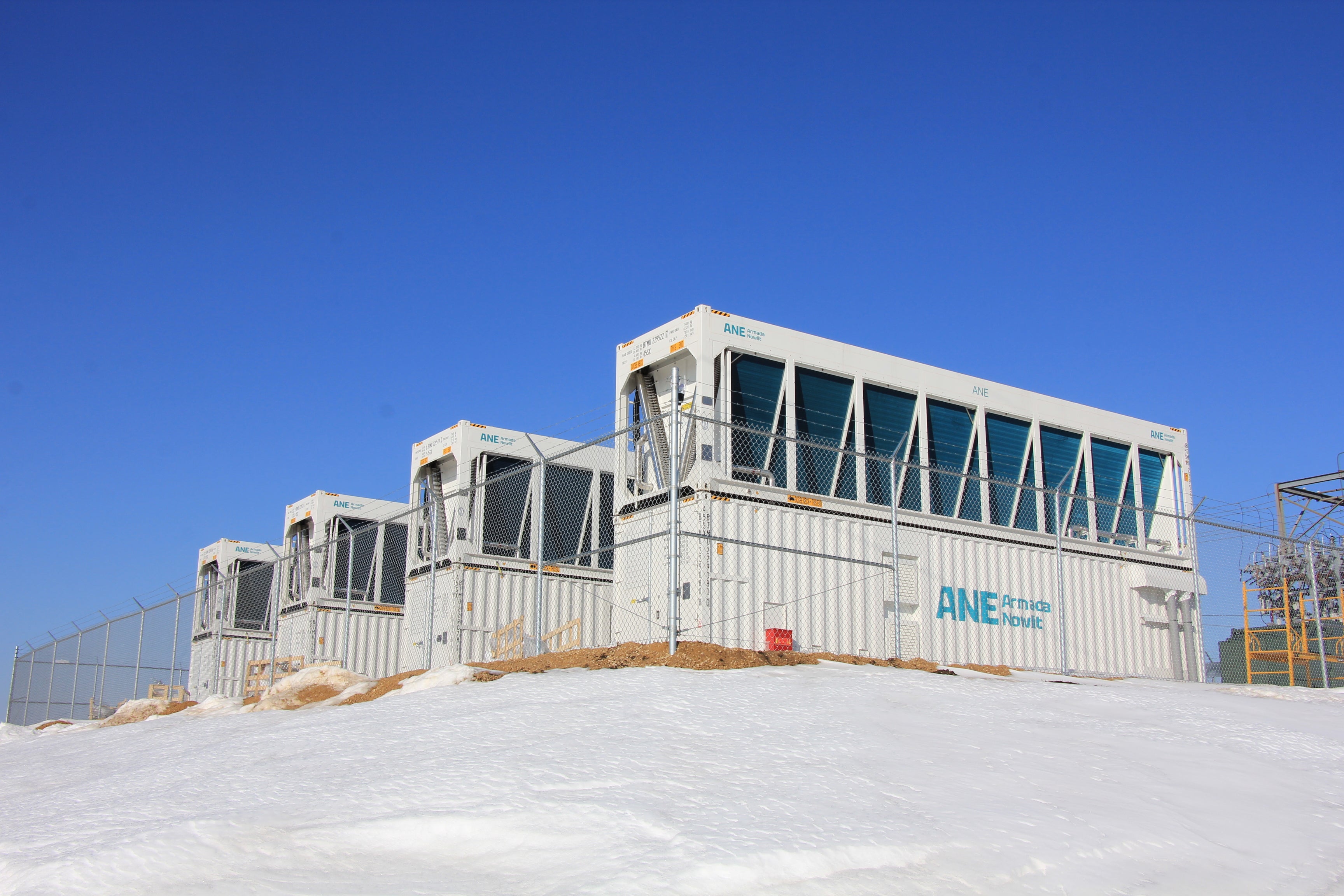
Currently, working with Riverland Energy Coop, we have eight project sites with 22 mining containers deployed, with a peak energy consumption of 44MW. Regarding the energy supply concerns raised by local residents, we make this solemn commitment: Anovary's operations will have absolutely no negative impact on the local community's power supply. We will never let our business operations affect the electricity stability of any single household. This is not only our commitment but also Riverland Energy Coop's requirement. All project planning has undergone rigorous stability studies by Riverland Energy Coop. Furthermore, we have assisted Riverland Energy Coop in upgrading the local electrical infrastructure, thereby increasing the overall available electricity in the region.
VALUE AND ASSURANCE FOR THE COMMUNITY
We fully understand the local community's concerns. The following three key facts ensure that Anovary's operations onlybring benefits to the local community:
1. Flexible Load Response and Grid Support (Curtailment)
Regarding Anovary's Bitcoin mining operations, while we are a large electricity consumer, based on Bitcoin mining's inherent curtailable characteristic, we have explicitly stated in our agreement with Riverland Energy Coop: all our electrical load voluntarily serves as peak-shaving resources to help the grid reduce peak loads during high-pressure periods. This has been verified at our Chippewa Valley site—from last October to present, we have achieved 100%response rate with power shutdown within 10 seconds for all grid requirements, without missing a single instance. Furthermore, our operations management software includes a dedicated management portal for Riverland Energy Coop. If Riverland staff detect that the system has not responded in time, they have the highest priority operational authority to manually shut down our operations. This ensures that the entire operation can respond immediately when the grid needs it. From the very beginning of planning, Riverland has always prioritized ensuring local electricity stability.
2.Securing Power Capacity and Upgrading Regional Grid
The concept of "limited grid power" requires some explanation. The grid's capacity to supply electricity during the same time period is limited, and this limitation is reflected in regional allocation. The allocation from the main grid through large power plants to various distributive coops is quota-based. If Buffalo County doesn't use this portion of the main grid capacity, it could be allocated to other counties. However, without customer demand, Riverland Energy Coop cannot pre-allocate more capacity to a designated region. Rather than saying Bitcoin mining consumes electricity, it's more accurate to say Anovary's operations help the region "capture" and secure more power resources while facilitating power system upgrades. Therefore, when regional demand increases in the future, Riverland will be more prepared because Buffalo County has already secured this capacity. Our operation essentially provides a 1:1 backup for local power demand. When infrastructure issues arise, our electrical load becomes an important guarantee ensuring local families and businesses have available electricity. This is Riverland Energy Coop's requirement, and we respond unconditionally.
3.Strategic Reserve for Economic Development
Because Buffalo County now possesses these secured power resources, on one hand, it has sufficient redundancy to address the growing electricity demands of households, farms, and businesses. On the other hand, in future economic development, this provides strong support for local business attraction—we can provide sufficient power resources with extremely short lead times. Anovary commits to Riverland Energy Coop that a portion of the capacity we use will serve as an "economic reserve." When local development needs arise, this can be permanently returned to local use as rapidly deployable power resources. At that time, we will coordinate with Riverland Energy Coop to relocate this load to new areas. This essentially creates a pre-built buffer for regional economic development, which is also a forward-thinking requirement that Riverland has proactively established for regional development and stability.
TECHNOLOGICAL INNOVATION AND ENVIRONMENTAL FRIENDLINESS
To better integrate into this community, we have made technical efforts that distinguish us from traditional mining facilities:
1.Fully Enclosed Liquid Cooling System, Eliminating Noise Concerns
Unlike traditional air-cooled Bitcoin mining facilities with fan walls, our mining containers employ a heat exchange circulation liquid cooling system. Therefore, the noise pollution often mentioned in the news does not exist at our sites. We use a fully enclosed liquid cooling system with only small fans at the top to facilitate plate heat exchanger cooling. Given Wisconsin's regional temperatures, the fan utilization rate is very low.
2.Closed-Loop Pollution-Free Design and Heat Energy Secondary Utilization
Although our sites are located outdoors, our entire circulation system is fully enclosed, using antifreeze for internal circulation without any interaction with the external environment. There are no water supply or discharge requirements, producing no pollution whatsoever. Furthermore, because the mining containers generate substantial heat energy, we have the capability to reuse this heat energy for secondary value. As a simple example, if local farmers are interested in building greenhouses next to mining containers to grow off-season crops, we are very willing to discuss cooperation, using mining container heat to empower local traditional industries and create new opportunities.
A LETTER TO THE COMMUNITY
I personally have over ten years of experience in the oil and gas industry in Texas and have spent considerable time living in farming rural areas. I fully understand the concerns that rural community members and farmers have about these new industries. I can assure everyone that Anovary has come here to join this community and create value, promoting regional economic development. We hope to become part of the community and are always ready to contribute whatever help we can provide.
Sincerely,
ANOVARY Management Team